
Jesus Christ has risen today! Alleluia!
Wishing everyone a joy-filled Easter Season! Remember the Good News–because of what Jesus did, we can live FOREVER with God! Alleluia!

Jesus Christ has risen today! Alleluia!
Wishing everyone a joy-filled Easter Season! Remember the Good News–because of what Jesus did, we can live FOREVER with God! Alleluia!
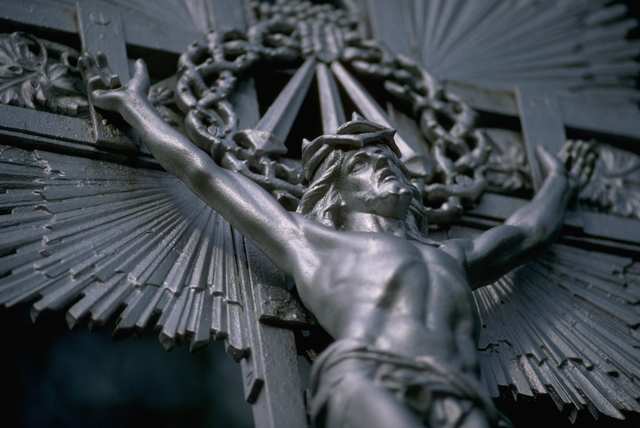
Because I wasn’t baptized until I was twenty-five, I didn’t have much experience going to church. It took me a long time to become comfortable with the rituals of the Catholic Mass. Today, I love the Mass. I tend to prefer Ordinary Time over the crowded Christmas and Easter Masses (I know, that’s not very Christian). I think the Chrism Mass is my favorite, a joyful Mass when all the priests in the diocese renew their vows. But the most moving Mass I have ever experienced is the Solemnity of Good Friday.
Technically, the Good Friday service is not an actual Mass. The hosts are consecrated the night before during Holy Thursday.
I will never forget my first Good Friday experience. I walked into the church expecting it to be like any other Mass. But when I arrived, the people were already kneeling and silent. When I looked up into the sanctuary, my heart skipped a beat. The hanging crucifix had been covered. I saw the priest and deacon laying prostrate under it. The tabernacle was empty, doors opened. After a reading of the entire passion, everyone was invited to venerate the cross. Each person took a turn to kiss, kneel before, or somehow give honor to the heavy wood of the cross, which was held up by the priest and deacon. In the background, the most beautiful, haunting music was being sung.
Poignantly aware of how Jesus suffered and died for us, I am grateful. The darkness and bleakness of a world without Jesus makes me gasp for air.

Before I became a Christian, I had heard of the Ten Commandments. When I became a Christian, I learned about the Eight Beatitudes. But it wasn’t until I read Matthew’s Gospel straight through for the first time that I learned of the “Seven Woes.”
I have never heard the “Seven Woes” of Jesus ever discussed in church. Why are they so important? Because in them, Jesus confronts the scribes and Pharisees, the religious leaders of his time. His outrage towards them is chilling, and he doesn’t mince words. After enduring Jesus’ biting attack, it is no mystery why the religious leaders wanted Jesus dead. He was a fantastic threat, to say the least, and that is why he was crucified.
The “Seven Woes” are found in Chapter 23 of Matthew, but I highly recommend reading the entire chapter. It only takes a few minutes. Here is an abbreviated version of them
“Woe to you, scribes and Pharisees, you hypocrites. You lock the kingdom of heaven before human beings. You do not enter yourselves, nor do you allow entrance to those trying to enter.”
“Woe to you, scribes and Pharisees, you hypocrites. You traverse sea and land to make one convert, and when that happens you make him a child of Gehenna twice as much as yourselves.”
“Woe to you, blind guides, who say, ‘If one swears by the temple, it means nothing, but if one swears by the gold of the temple, one is obligated.’ Blind fools, which is greater, the gold, or the temple that made the gold sacred?”
“Woe to you, scribes and Pharisees, you hypocrites. You pay tithes of mint and dill and cumin, and have neglected the weightier things of the law: judgment and mercy and fidelity. [But] these you should have done, without neglecting the others. Blind guides, who strain out the gnat and swallow the camel!”
“Woe to you, scribes and Pharisees, you hypocrites. You cleanse the outside of cup and dish, but inside they are full of plunder and self-indulgence. Blind Pharisee, cleanse first the inside of the cup, so that the outside also may be clean.”
“Woe to you scribes and Pharisees, you hypocrites. You are like whitewashed tombs, which appear beautiful on the outside, but inside are full of dead men’s bones and every kind of filth. Even so, on the outside you appear righteous, but inside you are filled with hypocrisy and evil.”
“Woe to you, scribes and Pharisees, you hypocrites. You build the tombs of the prophets and adorn the memorials of the righteous, and you say, ‘If we had lived in the days of our ancestors, we would not have joined them in shedding the prophets’ blood’ Thus you bear witness against yourselves that you are the children of those who murdered the prophets; now fill up what your ancestors measured out! You serpents, you brood of vipers, how can you flee from the judgement of Gehenna?…” Matthew 23:13-36
I grew up with no religion and, thus, had this image of Jesus as being weak because all he seemed to preach about was love, giving, and forgiving. While all of this was true, it was important for me to find out that he also experienced frustration and outrage, as he demonstrates here. I found this passage at a time when I was also disturbed by the behavior of the religious leaders of my faith. How does Jesus react? He doesn’t complain, sulk, or gossip. Rather, he confronts the leaders directly, a courageous thing to do. He takes action and gets himself tortured and murdered. I am in love with him again.

“He had an infectious laugh.” “Her smile lit up the room.” “He was always thinking of others.” “She would do anything for you.” “He was the life of the party with his great sense of humor.” These are sentiments we’ve all heard at a funeral or read in an obituary. Sincere tributes to the person who passed away. But I’ve often wondered…what about me? What will people say about me when I’m gone?
Being a true introvert, I am far from the life of the party. Rather, I am more likely to seek out the corner of the room and have a one-on-one conversation with someone else who is uncomfortable. Better yet, if there is a dog or cat present, it becomes my buddy for the night.
While I have a sense of humor, it is not always appropriate or appreciated, and I’m not good at telling jokes. My smile does not light up the room. I know this because, much to my annoyance, I have been told to “smile” more times than I can count. Often, I must appear more upset than I actually am due to the amount of times people ask me, “What’s wrong?” or tell me to, “Cheer up!” Excuse me, I am just fine. I am simply pondering the mysteries of the universe, and it is none of your business, anyway. Besides, this idea that women have to smile all the time is so sexist. I mean, how many times have I seen a man with a scowl or serious expression on his face? No one demands him to smile.
“She would do anything for you” is also not an apt description of me. While I do try to be kind and merciful and generous, it doesn’t come naturally. I’m afraid I must admit that I am sometimes self-absorbed, and I’ve been known to complain if someone messes with my routine. Ultimately, I usually do the right thing, but it doesn’t come easily. I envy and am in awe of people who are so naturally kind, generous, and loving.
A quote from C.S. Lewis in “Mere Christianity” gives me comfort:
I see my temperament as one of those “wretched machines.” I am not by nature a joyful Christian. Trying to be Christ-like, for me, requires effort. I know people who are by nature more loving and Christ-like than me who have not professed a relationship with God. Lewis explains this by going on further to say that having a “nice” temperament is God’s gift to us, not our gift to God. In other words, friendly, charming people are sometimes just born that way, it is not through any great effort of their own. Regardless, we are all expected to use and grow our God-given gifts wisely no matter what temperament we have been given.
Finally, I am reminded of a quote that I heard from a priest on retreat. He said,
We all know some of those non-prophet types.
But as I’ve grown older, I hesitate to speak my mind less and less–especially in church related matters. While I choose to practice my faith in the Catholic Church, I am not what you would describe as a good, obedient Catholic. I have even confronted priests at times when I thought their behavior was not fitting of their position. My spiritual directors have all, for the most part, encouraged me. One of them warned me that if I ticked off a certain priest, he could remove me from my ministries. It was a risk that I was willing to take. (He didn’t by the way).
And remember John the Baptist? Do you think he had a smile that lit up the room? Does he strike you as someone who would do anything for anyone? I can’t imagine him with an “infectious laugh.” Since he was beheaded by King Herod, we know that not everyone liked him. He was concerned for others, I’ll give him that…baptizing everyone, including Jesus, in the Jordan River…and Jesus loved him!
My point is this, you don’t have to be liked by everyone. You just need to do God’s will for your life with the machine He has given you. I don’t want to take away from all the lovely, kind, smiling, and generous people who have left this world empty and mourning their loss. I just want to suggest that it might not be such a bad thing to be remembered as a “pain in the a**.”
Lewis, C. S. (1952). Mere Christianity. New York: MacMillan Pub.
 Reflections in the Spirit of St. Julian